

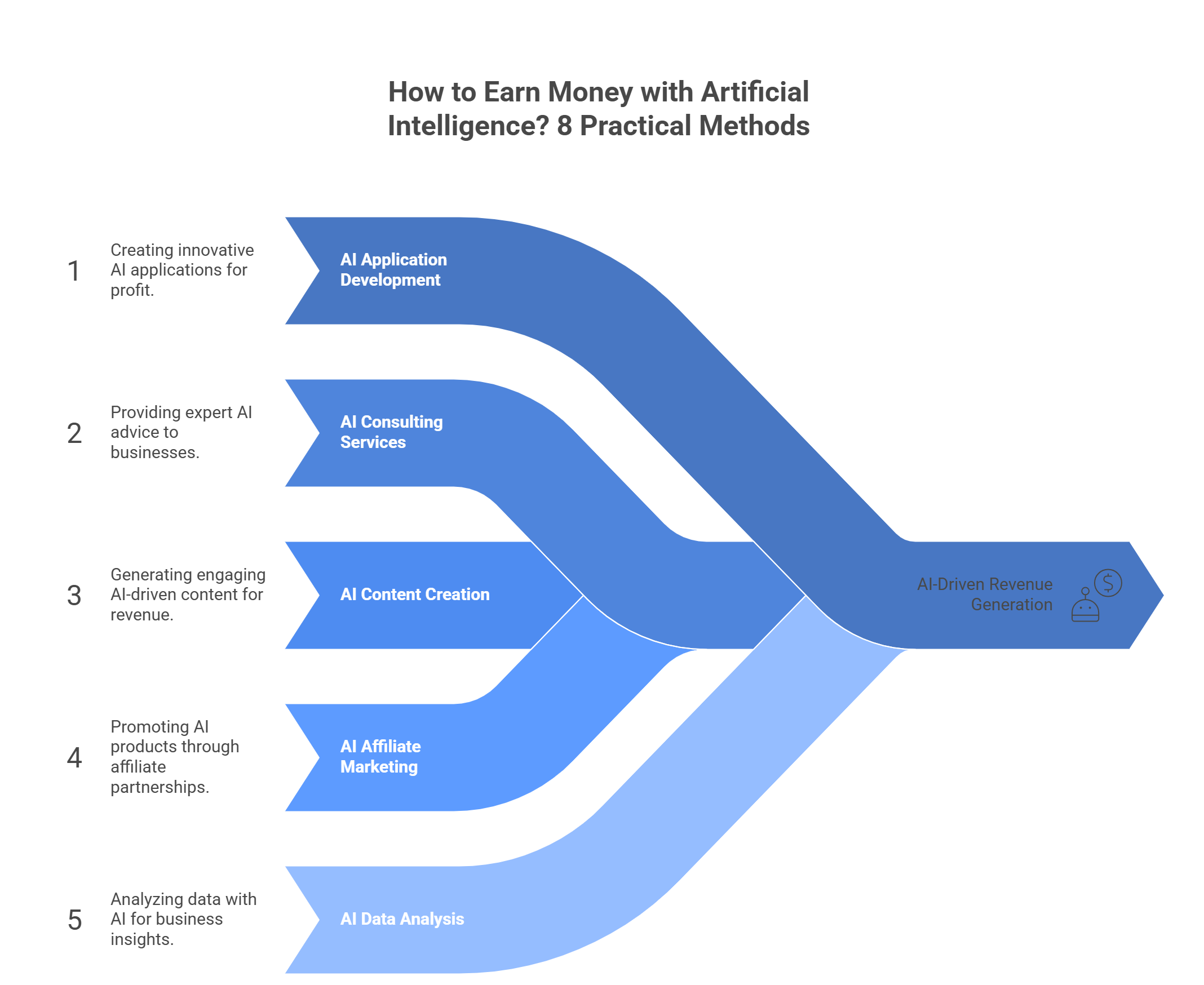
How to Earn Money with Artificial Intelligence? 8 Practical Methods
The global economy is currently navigating a profound structural transformation driven by the maturation of Artificial Intelligence (AI).
By 2025, AI has evolved from a speculative technological novelty into a fundamental economic infrastructure. This shift is fundamentally altering the mechanisms of value creation for everyone from freelancers to large enterprises.
For entrepreneurs, this marks a critical transition from labor-based income—where revenue is tethered to hours worked—to leverage-based income.
In this new model, AI systems amplify output to create nonlinear revenue potential. It is no longer about how hard you work, but how effectively you can orchestrate intelligent systems.
Current market data indicates a clear bifurcation in the economy.
First, there is “active” AI utilization, which enhances productivity in service roles. Second, there is “passive” AI asset generation, which creates autonomous revenue streams.
While early adopters in 2023 capitalized on basic arbitrage—generating low-quality content at scale—the market in 2025 demands sophistication.
Platforms like Google and YouTube now prioritize value over volume. This pushes the market toward “AI-assisted” models that require human strategic oversight, rather than purely “AI-generated” spam.
The fastest path to monetization involves selecting pricing models that map directly to customer value.
This guide provides an expert-level analysis of the AI economy, dissecting distinct methods for monetization. We will explore operational workflows, economic models, and strategic nuances required for success.
1. The Rise of the “Centaur” Freelancer: Service Automation
The freelance economy has served as the vanguard for AI integration.
Contrary to fears of mass displacement, data reveals a restructuring of the market rather than a collapse. A clear divergence has emerged between “commodity” freelancers and “AI-augmented” experts.

In 2025, the most successful freelancers operate as “Centaurs.” This term denotes the hybridization of human strategic oversight and AI execution.
Copywriting and Content Strategy
The traditional model of charging per word is obsolete for low-complexity content.
Tools like Jasper and advanced Large Language Models (LLMs) have driven the marginal cost of generic text to near zero. Consequently, the value proposition has shifted to strategy, editing, and voice.
Modern copywriters function as “Editors-in-Chief” of their own AI writing teams. They use tools like SurferSEO to define topical relevance and LLMs to generate drafts.
The human role is to refine tone and inject brand voice. This allows a freelancer to quintuple their capacity without sacrificing quality.
Graphic Design and Visual Assets
Designers now integrate generative tools like Midjourney and Adobe Firefly into professional workflows.
The ability to generate assets is no longer the bottleneck; the skill lies in curation. Designers use AI to generate dozens of conceptual iterations in minutes, accelerating client feedback loops.
The “best” designers are now those who can effectively prompt-engineer complex visual concepts. They then manually refine these outputs in professional software like Photoshop.
Coding and Technical Development
AI-assisted coding using tools like GitHub Copilot has revolutionized development.
Developers report 30-50% reductions in coding time for routine functions. This efficiency dividend allows freelancers to take on more concurrent projects.
Table 1: The Shift in Freelance Pricing Models
| Service Category | Traditional Rate (2023) | AI-Augmented Rate (2025) | Key Value Driver |
| Blog Writing | $0.10 – $0.20 / word | Flat Fee ($100 – $300 / package) | SEO Strategy & Volume |
| Graphic Design | $50 – $100 / hour | Project Fee ($500 – $2,000) | Speed of Iteration |
| Web Development | $75 – $150 / hour | Fixed Bid ($2,000 – $10,000) | Full-Stack Capabilities |
| Translation | $0.08 – $0.12 / word | Hourly ($50 – $100 / hour) | Cultural Localization |
2. Automated Content Creation: The Industrialization of Media
Content creation has shifted from a personality-driven model to a process-driven model.
The concept of “faceless” channels and automated blogs has matured. It is no longer a “get rich quick” scheme but a legitimate, scalable media business model.
Faceless YouTube Channels
These channels leverage stock footage, AI voiceovers, and AI-written scripts to produce content at scale.
This model effectively decouples the creator’s identity from production. The workflow for 2025 is highly streamlined:
- Ideation: Tools like VidIQ analyze trending topics and high-CPM niches (e.g., Finance, Tech).
- Scripting: LLMs like Claude generate scripts optimized for retention, focusing on “hooks” and engagement triggers.
- Voiceover: Text-to-Speech technology from ElevenLabs provides near-human narration.
- Visuals: AI video generators like Sora and Runway Gen-2 create the visual layer.
Note: YouTube allows monetized AI content but requires strict disclosure for synthetic media. To qualify for AdSense, content must provide genuine educational or entertainment value.
AI-Driven Blogging and SEO
The strategy for blogging has shifted from “writing posts” to “building topical authority.”
AI tools analyze a niche and generate a comprehensive map of interlinked topics. This is known as Programmatic SEO.
For data-driven niches, AI can generate thousands of landing pages based on structured data sets. However, success requires a “Human-in-the-Loop.”
Google’s algorithms penalize unhelpful content. Successful bloggers must manually inject personal anecdotes, expert quotes, and unique data to satisfy E-E-A-T (Experience, Expertise, Authoritativeness, Trustworthiness) guidelines.
3. Productizing Knowledge: Digital Assets and SaaS
The “write once, sell forever” nature of digital products makes them the holy grail of passive income.
AI has dramatically reduced the friction of creating these assets. Creators can now launch comprehensive libraries of products in weeks rather than years.
The Ebook and Course Renaissance
AI assists in every stage of creation, from outlining chapters to drafting content.
An ebook that previously took three months to write can now be drafted in a week. However, market saturation is a risk.
Success in 2025 requires proprietary knowledge. The best-selling AI-assisted books rely on the author’s unique data or case studies for substance, using AI only for structure.
Platform Comparison for Course Sellers:
- LearnWorlds: Best for interactive learning with AI course generators.
- Heights AI: Ideal for solopreneurs needing an AI coach.
- Teachable: Focuses on marketing with AI sales page builders.
- Udemy: Best for traffic, but takes a high revenue share.
Micro-SaaS and Vertical AI
For those with technical skills, building Micro-SaaS products targets specific problems large models ignore.
General models like GPT-4 are wide but shallow. Vertical AI is narrow but deep.
For example, instead of a “General Writing Assistant,” an entrepreneur might build a “Grant Writing Tool for Non-Profits.”
No-code builders like Bubble allow entrepreneurs to wrap OpenAI’s API without writing code. This dramatically lowers the cost of MVP development.
Checklist for Validating Micro-SaaS Ideas:
- [ ] Identify Pain Point: Find a boring, manual process in a specific industry.
- [ ] Fake Door Test: Create a landing page with AI-generated copy and mockups.
- [ ] Run Ads: Spend small amounts ($50) to test click-through rates.
- [ ] Build MVP: Only build the software if people try to sign up.
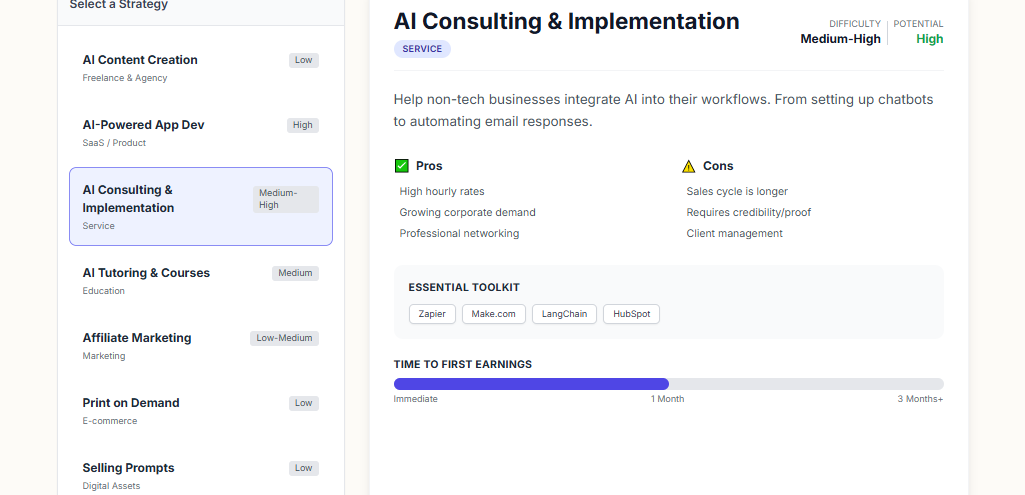
4. The B2B Frontier: Consulting and Automation Agencies
As businesses scramble to adopt AI, there is a massive knowledge gap.
Companies have the budget but lack the expertise. This has birthed a lucrative consulting and service sector.
AI Consulting and Prompt Engineering
Prompt engineering has evolved into “system architecture.”
Senior consultants command high rates for designing complex prompt chains and integrating LLMs into business logic.
Services include optimization (reducing token usage), persona design for chatbots, and workflow audits.
Automation Agencies
This involves acting as an external agency that builds automated systems for other businesses.
Agencies use tools like Zapier and Make to connect business apps with AI logic.
Examples include automated lead processing, customer support agents, and review management systems.
Agency Pricing Benchmarks:
| Service Type | Setup/Project Fee | Monthly Retainer |
| AI Marketing Automation | $2,000 – $10,000 | $1,000 – $5,000 |
| Custom AI Development | $50,000+ | $10,000+ |
| Support Chatbots | $5,000 – $15,000 | $500 – $2,500 |
The “White Label” Model
A significant opportunity exists in white-labeling AI tools.
Developers can approach a small business, such as an accounting firm, and build a “Tax Assistant Bot.”
This bot is trained on their specific client data and local tax codes. The developer charges a setup fee and a monthly maintenance fee to keep the API running.
Conclusion: The Future of AI Revenue
Earning money with AI in 2025 is no longer about the novelty of the technology.
It is about the integration of technology into value chains. The “easy money” era of low-effort content arbitrage is ending.
The new era belongs to those who use AI to amplify human creativity and streamline complex operations.
Whether through freelancing, product creation, or software development, the common denominator is leverage.
You must focus on using AI to do more with less, better than ever before.
The landscape clearly distinguishes between Active Income (freelancing/consulting) for cash flow, and Passive Income (digital products/SaaS) for wealth building.
The most resilient entrepreneurs will combine both, building a diversified portfolio of AI-powered revenue streams.