

AI Virtual Assistant Softwares In UAE create ai voice agent dubai
The United Arab Emirates is no longer just a consumer of technology; it is rapidly becoming a global architect of the digital future.
Under the “We the UAE 2031” vision, the nation is pivoting from a service-based economy to a hyper-automated, knowledge-based ecosystem.
For businesses operating in Dubai and the wider GCC, this shift presents a critical turning point.
AI Virtual Assistants—specifically Voice AI Agents—have graduated from simple customer support tools to essential infrastructure.
We are witnessing the rise of “Agentic AI” in the Emirates.
These are systems capable of autonomous reasoning, complex task execution, and natural, multi-turn conversations in Arabic and English.
However, deploying these “Digital Employees” in the UAE is not as simple as copying a model from Silicon Valley.
You must navigate complex linguistic landscapes, strict data sovereignty laws, and unique cultural expectations.
This guide provides the operational roadmap you need to build, deploy, and scale compliant AI voice agents in the UAE.
The Strategic Shift: Why Voice AI is Booming in the GCC
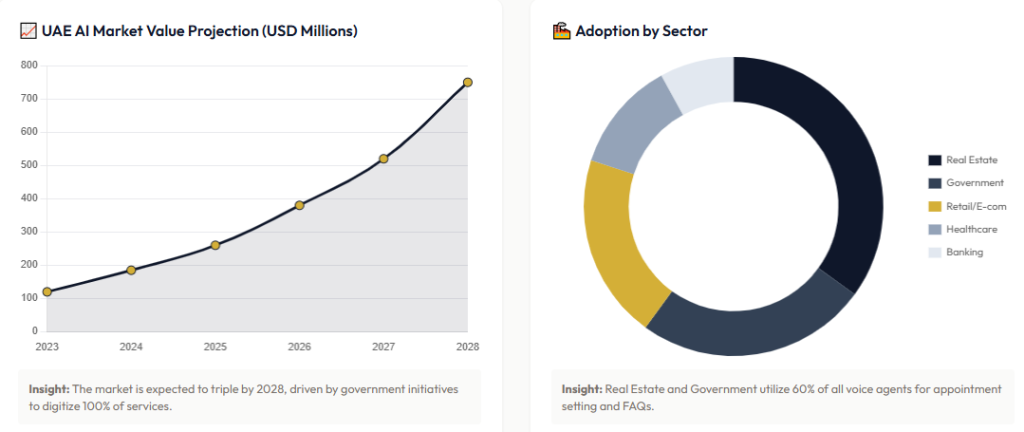
The adoption of AI in the UAE is driven by a convergence of government policy and economic necessity.
The government has explicitly positioned the nation as a global testbed for AI innovation.
With the appointment of a Minister of State for AI and the “Centennial 2071” project, the public sector is leading by example.
You can now find “Digital Humans” and voice-enabled kiosks handling residency and licensing inquiries in government centers.

Economic Efficiency and the 24-Hour Economy
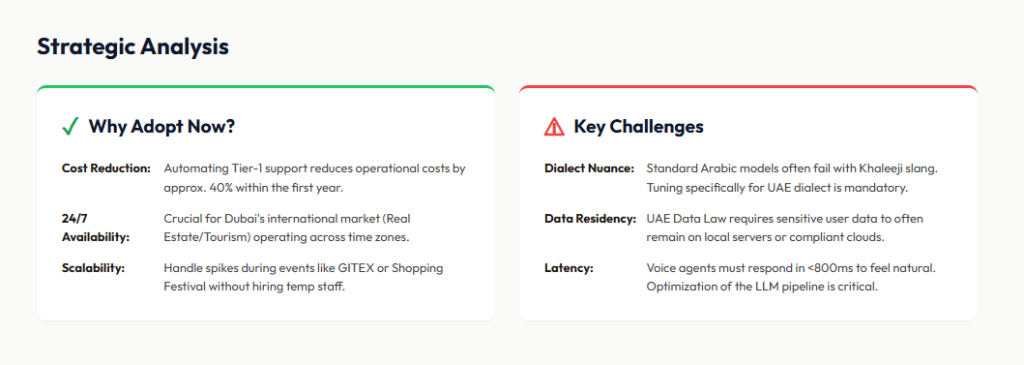
For the private sector, the primary driver is clear: cost reduction and capacity scaling.
The cost of skilled, multilingual human labor in customer-facing roles is high.
Data suggests that AI voice agents can reduce operational support costs by up to 70%.
Dubai operates as a 24-hour economy, driven by international trade and tourism.
Human agents cannot physically cover every time zone without incurring massive overtime costs.
AI agents provide an “always-on” solution, offering instant support at 3 AM without fatigue.
The Cultural “Politeness” Parameter
Why is voice winning over text?
While chatbots have existed since 2017, they often fail in the GCC market.
Text interfaces can feel dismissive and impersonal.
Culturally, the GCC market places a massive premium on verbal communication and warmth.
A successful AI agent in Dubai must mimic this human connection.
It must utilize polite greetings like “Assalam Alaykum” and respect honorifics.
Modern Voice AI has reduced latency to under 800 milliseconds.
This allows for fluid interruptions and back-and-forth dialogue, making the AI feel less like a robot and more like a helpful assistant.
Navigating the Regulatory Minefield: Compliance is Non-Negotiable
Before writing a single line of code, you must understand the legal landscape.
The UAE has some of the strictest privacy and telecommunications laws in the world.
Ignoring these can lead to severe financial penalties and criminal liability.
Call Recording and “Two-Party Consent”
The UAE Penal Code and Cybercrime Law create a high-stakes environment for voice recording.
Unlike many western jurisdictions, the UAE is a strict “two-party consent” state.
You cannot record a conversation unless the other party is fully aware.
Compliance Requirement:
Every AI interaction must begin with an unequivocal disclaimer.
You must program your agent to say: “This call is being recorded for quality and training purposes.”
Continuing the call after this disclaimer generally constitutes implied consent.
However, for sensitive sectors like banking, explicit verbal consent (“Do you agree?”) is highly recommended.

Data Sovereignty and The Cloud
The UAE Personal Data Protection Law (PDPL) dictates how personal data is processed.
For government, healthcare, and finance sectors, data residency is critical.
Data often must be stored and processed within the physical borders of the UAE.
Historically, this limited the use of US-based LLMs.
However, the landscape changed in 2025.
OpenAI expanded data residency services to the UAE, and local telecoms like e& (Etisalat) launched “Sovereign Launchpads.”
This allows enterprises to use powerful models like GPT-4o while keeping data-at-rest within the country.
The VoIP Hurdle
The Telecommunications and Digital Government Regulatory Authority (TDRA) heavily regulates Voice over IP.
You cannot simply use unauthorized offshore VoIP providers.
To operate legally, your AI agent must utilize SIP trunks provided by licensed carriers like Etisalat or Du.
Furthermore, outbound calling requires verified “local presence.”
Using international numbers for local outreach will likely result in your calls being flagged as “Potential Spam.”
Regulatory Checklist for UAE Voice Agents
- Disclaimer: Is the pre-call recording notification active?
- Hosting: Is user data stored on UAE-based servers or compliant cloud regions?
- Telephony: Are you using a licensed SIP provider with a +971 number?
- Verification: Have you submitted a Letter of Authorization (LOA) to the carrier?
The Ecosystem: Top Platforms and Agencies for 2025
The market is split between “Engine” providers (SaaS) and “Builders” (Agencies).
Choosing the right partner depends on your internal technical capability.
SaaS Orchestration Engines
These platforms handle the complex connection between Telephony, Speech-to-Text, and the LLM.
- Retell AI: A dominant player for developers. It focuses on low latency (~800ms) and handles “turn-taking” logic well. It supports verified UAE numbers.
- Vapi: A highly customizable orchestrator. It allows you to keep business logic on your own servers, which is excellent for data sovereignty.
- Brightcall: A provider with a strong local presence in JLT, Dubai. They focus on sales automation and align closely with local telecom operators.
- Verloop.io: Specialized in Arabic NLP. They excel at handling Khaleeji, Egyptian, and Levantine dialects.
Leading Development Agencies
If you lack an engineering team, these agencies offer turnkey solutions.
- Techling: A UAE-based developer known for banking fraud bots and retail automation.
- Thinkstack: An “Arabic-First” agency. They train models natively on Arabic datasets rather than translating from English.
- Sapphire Software Solutions: Great for complex RAG (Retrieval Augmented Generation) integrations involving large databases.
Comparative Matrix: SaaS vs. Agencies
| Feature | SaaS Platforms (e.g., Retell, Vapi) | Development Agencies (e.g., Techling) |
| Target Audience | CTOs, Developers, Tech SMEs | Non-technical Enterprises, Gov |
| Cost Model | OPEX (Per minute usage) | CAPEX (Project Fee) + Maintenance |
| Time to Deploy | Fast (Days) | Medium (Weeks/Months) |
| Customization | Constrained by platform | Unlimited (Custom Code) |
| Arabic Support | Good (Model Dependent) | Excellent (Native Training) |
Technical Architecture: Building for Arabic and the Gulf
To build a “Dubai-Grade” agent, you need a specific technology stack.
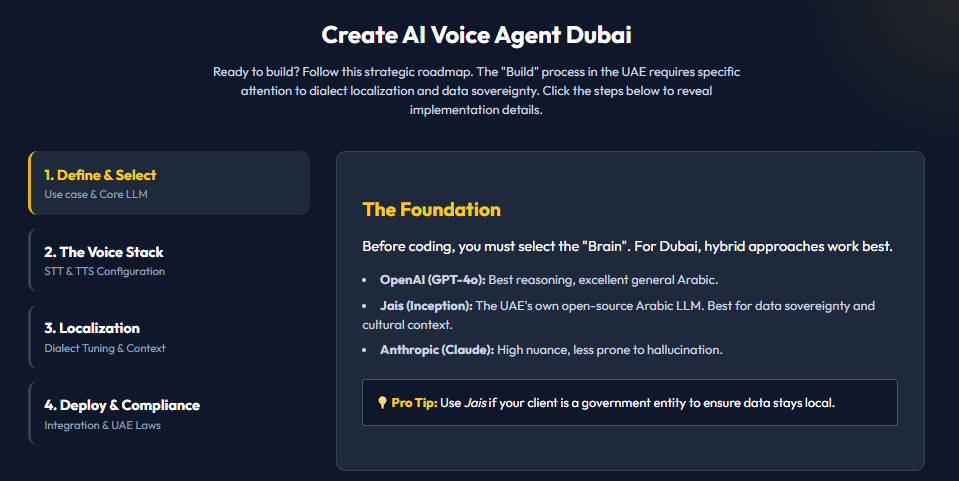
The Brain: Large Language Model Strategy
The LLM is the cognitive engine of your agent.
OpenAI GPT-4o: Currently the standard for reasoning. With UAE data residency, it is safe for most enterprises. It handles Modern Standard Arabic (MSA) exceptionally well.
Falcon / Llama 3: For strict sovereignty (e.g., Ministry of Defense), open-source models hosted on local Core42/G42 clouds are the only option.
The Voice: Text-to-Speech (TTS)
Latency is the enemy of conversation.
A delay of over 1 second breaks the immersion.
ElevenLabs: The market leader for natural intonation. Its “Turbo” models are essential for speed.
Dialect Tuning: Standard TTS voices often sound like a news anchor.
To achieve a local persona, developers use Voice Cloning to replicate a real UAE national’s voice.
This ensures the accent softens appropriately (e.g., the Gulf pronunciation of ‘qaf’ to ‘ga’).
The Ears: Transcription (STT)
The agent must hear clearly, even in noisy Dubai malls.
Deepgram: The preferred choice for real-time transcription.
It offers specific language codes for Arabic dialects and supports “endpointing.”
This technology detects when a user has actually stopped speaking versus just pausing for a breath.
Step-by-Step Implementation Guide
Follow this roadmap to deploy a functional, compliant agent.
Phase 1: Persona and Prompt Engineering
Define your agent. Is it “Layla,” the helpful concierge, or “Ahmed,” the serious banker?
The “System Prompt” is your most critical asset.
- Example Instruction: “You are a professional assistant for a Real Estate firm. You speak fluent English and Khaleeji Arabic. If the user greets you in Arabic, switch immediately.”
Phase 2: Integration with Local Infrastructure
To provide real value, the agent must connect to the UAE digital ecosystem.
UAE Pass Integration:
Since a voice agent cannot see a face, use “Out-of-Band” verification.
Trigger a push notification to the user’s UAE Pass app to authenticate them biometrically before discussing sensitive account details.
Payment Gateways:
Never ask a user to speak their credit card number. This violates PCI-DSS.
Instead, integrate with local gateways like Telr or PayTabs.
Have the agent generate a secure payment link and send it via WhatsApp while keeping the user on the line to confirm receipt.
Financial Analysis: The Cost of Intelligence
Is an AI agent cheaper than a human? Almost always, but you must understand the unit economics.
Cost Per Minute Breakdown
A typical conversation stack costs between $0.15 and $0.27 per minute.
- Orchestration: $0.05 – $0.08
- LLM Intelligence: $0.03 – $0.06
- Voice Synthesis: $0.05 – $0.10
- Telephony: $0.02
The ROI Calculation
Compare this to a human agent in the UAE.
A junior support staff member costs roughly AED 5,000 – 8,000 per month (including visa and benefits).
They work 8 hours a day, 5 days a week.
An AI agent costs roughly $500 – $1,000 per month for similar volume but is available 24/7/365.
The real ROI, however, is scalability.
An AI agent can handle 500 concurrent calls during a Ramadan marketing campaign.
Attempting to scale a human team to that level temporarily is operationally impossible.
Conclusion and Strategic Recommendations
The deployment of AI Virtual Assistants in the UAE is an operational necessity for the next decade.
However, a “copy-paste” of US solutions will fail here.
Success requires a deep respect for regulatory boundaries and cultural nuance.
Your Action Plan:
- Prioritize Compliance: Solve the data residency and recording consent issues first.
- Go Native: Invest in dialect-specific prompting and local voice cloning.
- Integrate Deeply: Connect your agent to UAE Pass and local payment systems to move beyond simple FAQ bots.
By following this roadmap, you can deploy a digital workforce that drives the next phase of your organization’s growth.